

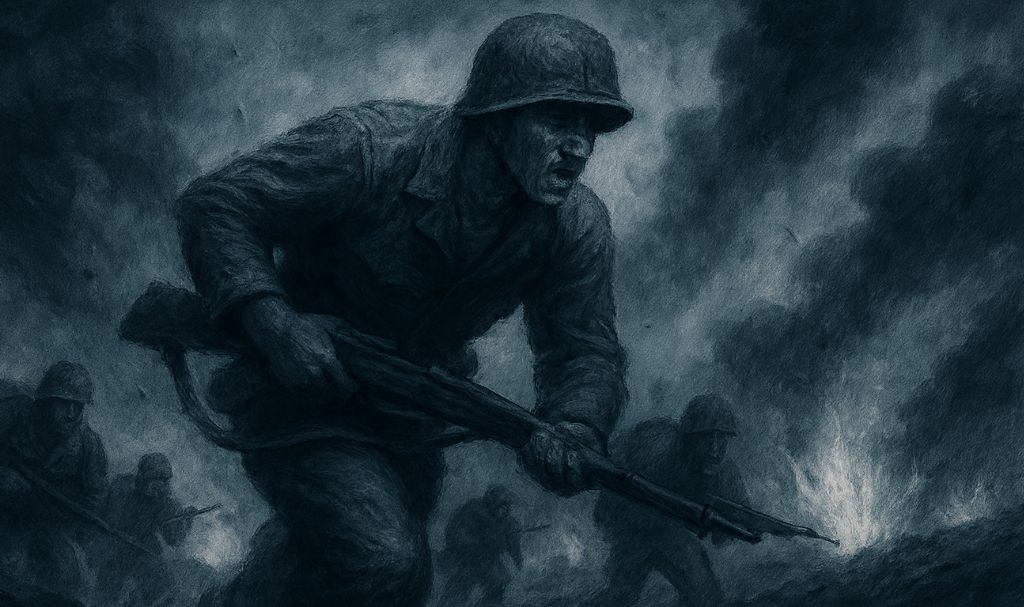
Some stories are not meant to be forgotten. They don’t even try, yet their impact is so strong that they leave a mark on everyone they reach. The stories of honor, courage, and resilience are among them. To depict this truth more powerfully, the book Iwo Jima “Give Me Fifty Marines Not Afraid To Die” does a remarkable job.
This Marine’s Memoir is not just the story of war; it is the record of the human spirit that shone through it. Unlike other war accounts that glorify combat, this Military Memoir tells how ordinary people stepped up when duty called. These are the stories of men who showed extraordinary strength and sacrifice, who put everything on the line for a cause greater than themselves.
This book is an honor to those men who fought without knowing whether their tomorrow was promised, yet they fought for a better tomorrow for everyone else. It reminds us that the victory and freedom we enjoy today were not earned easily. They were bought with the sacrifice of blood, of lives, and of everything those people once held dear.
An Embodiment Of Courage
Written by the platoon leader himself, Major John Keith Wells, this Memoir from Iwo Jima does not sugarcoat anything. It shows the brutal reality of battle, proving that the truth of war is far worse than any document can capture. Wells’ words, written with painful honesty, reveal both the brutality of the Battle of Iwo Jima and the fragile humanity of the men who fought it. He reminds readers that courage does not mean the absence of fear. It means standing up and moving forward while fear roars inside you.
This Marine’s Memoir also shows how a leader encourages his soldiers through action. One painful yet powerful instance that showcases courage and leadership came when Wells’ platoon was ordered to assault Mount Suribachi, the volcanic fortress at the island’s southern tip. The Japanese held the high ground, and the Marines had to cross open terrain under heavy fire.
Wells knew many of his men would die before reaching the mountain’s base. Yet he stood first, pointed his weapon toward the enemy, and ran forward. Behind him came his men, driven not by blind obedience but by trust in their leader. One lesson we can learn from this is that Wells did not simply order his men to move forward. Understanding the danger and the nature of the task, he led them himself. He stood tall, facing death, showing that a true leader does not send others to do what he is unwilling to do. His courage revealed the character and conviction required to lead.
Extraordinary in the Ordinary
The men who fought there showed that discipline is what keeps courage from breaking. They proved that resilience is not born overnight, but through training, faith, and a refusal to quit. The Battle of Iwo Jima also reminds us that leadership is not about commanding from safety. It is about standing shoulder to shoulder with those who trust you with their lives. Major Wells embodied that truth. His men saw him fight through pain and exhaustion, and that vision carried them through their own fear.
Even in civilian life, these lessons hold weight. Every challenge, every hardship, requires the same mix of resolve and unity. Wells’ memoir teaches that leadership is not about power it is about responsibility.
The Harsh Reality of War
The Memoir from Iwo Jima does not soften the horror. Wells describes the suffocating volcanic ash that swallowed boots and blood alike. He writes of the relentless artillery fire that made the air itself tremble and of the silence that followed an eerie calm somehow worse than the noise. There were no cheers on that island, no music to raise morale, only the sound of survival. Marines dug shallow foxholes in the ash, trying to protect themselves from an invisible enemy hidden below. Sleep was a luxury, food was scarce, and water was gold. The physical strain was enormous, but it was the emotional weight that scarred them most.
Watching friends fall and still finding the strength to move forward required a kind of endurance few can understand. In one passage, Wells writes of lying flat under a barrage so intense that the ground itself seemed alive. He wondered why air support had not come and why the Navy’s guns had fallen silent. Yet even in that despair, he never surrendered to hopelessness. He knew his men were watching, and his strength had to be theirs.
The Brotherhood of the Marines
One of the most striking parts of Wells’ Memoir from Iwo Jima is how it reveals the bond among the Marines. They were not fighting for medals or headlines they fought for the man beside them. It was not just a hierarchy of leaders and followers; it was a brotherhood. They kept each other going, lifting one another’s spirits when all seemed lost.
Wells said it was that bond and brotherhood that made survival possible. Otherwise, everyone was on the verge of breaking down. But together, they became the strongest. This Marine’s Memoir teaches that even in the gravest times, one can find meaning. In the midst of trauma and terror, moments of hope, laughter, and humanity can still exist. Between the noise of war and the silence that follows, there is still room for compassion and connection.
The Cost Of Victory
Of the forty-five men in Wells’ platoon, fifteen were killed, and nearly all the rest were wounded. The survivors carried invisible scars long after the war ended. Yet they also carried pride pride in having done their duty and in having stood together. Theirs was not a victory of conquest, but of character. The Marine’s Memoir of Iwo Jima stands as a timeless tribute to that character. It reminds us that courage is not the absence of fear but the mastery of it. It reminds us that honor is not found in medals but in the choices made when the world seems to collapse. And above all, it reminds us that survival itself can be an act of grace. The echoes of Iwo Jima still reach us today. They speak of men who refused to yield, who led with heart, and who fought with purpose. Their story is not only a chapter in military history but a lasting lesson in the strength of the human spirit.


